






Key takeaways
Instacart shoppers generally owe self-employment tax when their net earnings from self-employment are $400 or more. The self-employment tax rate is 15.3% for Social Security and Medicare.
For payments made in 2026, the federal Form 1099-NEC reporting threshold is $2,000. You must still report your income even if you earn less than the threshold and don't receive a 1099.
Mileage can be one of the largest tax deductions available to full-service Instacart shoppers. For 2026, the standard business mileage rate is 72.5 cents per mile from January through June and 76 cents per mile from July through December.
Not every mile you drive while working for Instacart is automatically deductible. Driving between stores, deliveries, and other eligible business stops can qualify, while driving between home and your first or last business stop may be considered commuting, which doesn't qualify.
Instacart shoppers can generally calculate eligible vehicle deductions using either the standard mileage method or the actual expense method. If you use standard mileage, you generally can't separately deduct vehicle costs, such as gas, insurance, maintenance, and depreciation. Keeper's mileage vs expenses calculator can help estimate which method gets you more deductions.
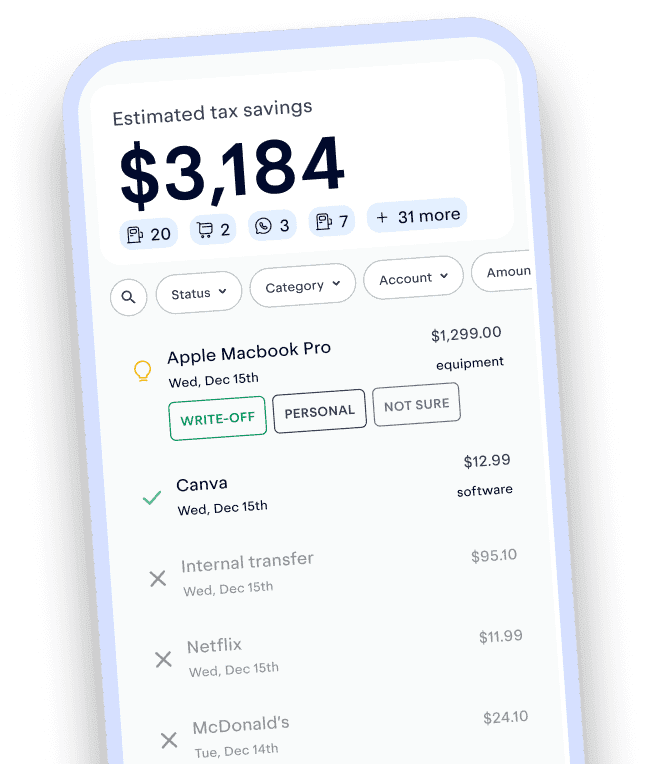
Other Instacart deductions can include the business-use portion of your phone expenses, insulated delivery bags, and eligible business parking fees and tolls. An app like Keeper can automatically scan your bank and credit card transactions for tax deductible expenses and categorize them for tax time.
Some Instacart shoppers need to make quarterly estimated tax payments if you expect to owe at least $1,000 in federal tax (after withholding and refundable credits), and you don't meet safe harbor.
Whether you deliver groceries full-time or as a side hustle, driving for Instacart has its perks. As a full-service shopper, you can set your own schedule and head out to the local stores whenever you want.
Still, working for yourself comes with its share of downsides — especially when tax time rolls around.
Don't stress. We'll go over everything you need to get your Instacart 1099 taxes right, from what you're on the hook for to the forms you need to file. Next, we'll teach you some tricks for lowering your tax bill by claiming write-offs. Finally, we'll dig into how — and when — to pay your taxes.
Full-service shoppers vs in-store shoppers
Instacart has two very different roles:
Full-service shoppers shop and deliver, set their own hours, and use their own car. You are an independent contractor, you get a 1099-NEC, and no taxes are withheld.
In-store shoppers only shop, work scheduled hours, and are W-2 employees. Instacart withholds your taxes, and you generally cannot deduct job expenses.
What taxes do Instacart shoppers pay?
Self-employment tax
Unlike in-store shoppers, Instacart delivery drivers have to pay self-employment tax. Also known as FICA tax, it’s how freelancers and independent contractors contribute to Social Security and Medicare.
W-2 employees also have to pay FICA taxes, to the tune of 7.65%. The amount they pay is matched by their employer.
As an Instacart driver, though, you're self-employed - putting you on the hook for both the employee and employer portions. That’s right: you'll have to pay that 7.65% twice over, for a total of 15.3%.
To make matters worse, that's on top of your federal and state income taxes.
To avoid getting sticker shock, use a self-employment tax rate calculator to make sure you’re setting enough money aside.
And before you start panicking, remember: There are ways to lower your taxes by claiming write-offs. We’ll go over that down below.
Quarterly estimated tax payments
The IRS expects you to make quarterly estimated payments, due in April, June, September, and January if you expect to owe $1,000 in taxes (after withholding and refundable credits are accounted for).
As a general rule of thumb, set aside 25% to 30% of your earnings so those payments are covered, and see our quarterly taxes guide for the mechanics.
You can use Keeper's quarterly tax calculator to see how much to pay.
What tax form does Instacart send?
Full-service shoppers get a Form 1099-NEC.
What | What to know |
|---|---|
Tax form | 1099-NEC |
Who gets a 1099 | Shoppers who made $2,000 or more |
Where to find it | The Instacart Shopper app |
If you filed in an earlier year, you may remember getting your form through Stripe Express. That changed. Since the 2023 tax year, Instacart delivers the 1099-NEC through the Shopper app instead.
Note: You still need to report your income and pay taxes even if you didn't receive a 1099! Check out our guide on what to do if you didn't get a 1099.
What can I write off as an Instacart shopper?
Luckily, you won't be taxed on all the income reported on your 1099-NEC. One of the perks of self-employment is getting to deduct all your business expenses from your income.
Self-employed people — especially side hustlers — tend to forget about these write-offs, which means they end up overpaying the IRS at tax time. To hang on to your hard-earned dollars, make sure you keep track of everything you buy for work.
For Instacart drivers, that means starting with your auto expenses.
Deductions | Notes |
|---|---|
Mileage | Business miles at 72.5 cents for the first half of 2026, 76 cents for the second half (70 cents for 2025). |
Phone bills | The business-use share of your cell phone bill |
Insulated bags | Cooler bags and delivery equipment |
Tolls and parking | These are deductible on top of the mileage rate! |
Actual car costs (gas, car insurance, car maintenance, etc.) | These are deductible only if you use the actual-expense method instead of the standard mileage method! |
Track and claim every eligible deduction with Keeper
Keeper scans your accounts for write-offs and files your return — with tax pros reviewing every one.
Try it freeSome things to be aware of:
Mileage is typically the deduction that saves shoppers the most, and Instacart does not track it for you. You'll need to use a mileage tracker or log them yourself.
The business miles that count run from accepting a batch, to the store, between stores on a multi-store batch, and to each customer. The drive to and from home is considered personal commuting, and not deductible.
You have to pick between the standard mileage or actual expenses method for your deductions. You can't use both. Keeper's mileage vs expenses calculator can help you estimate which method nets you the most tax savings.
Pros and cons of the standard mileage method vs actual expenses method
Standard mileage method | Actual expenses method | |
|---|---|---|
Pros | You can switch between methods if you use this in your first year You'll get a bigger tax break if you drive a lot | You'll be able to deduct vehicle depreciation You'll get a bigger tax break if you drive a typical amount |
Cons | You'll get a smaller tax break if you drive a typical amount You'll have to track the number of miles you drive | You're locked into this method if you use it in your first year You'll have to sum up all your car expenses |
How to file your Instacart taxes
Gather your records. Your 1099-NEC from the Shopper app, your earnings history, and your mileage log.
Total your income, including tips, which are taxable (don't worry - you can deduct up to $25,000 in tips!)
Add your deductions. Decide whether the standard mileage or actual expenses method is better for you.
Report your net profit on Schedule C, then calculate self-employment tax on Schedule SE.
Make quarterly estimated tax payments (January 15, April 15, June 15, September 15) if you expect to owe $1,000 or more.
Over 1M Americans trust Keeper for their complex taxes
The #1 tax app for freelancers, gig workers, and self-employed filers.
Get started free

FAQs
What tax form will I get from Instacart?
Full-service shoppers get a 1099-NEC.
Where do I find my Instacart 1099?
In the Instacart Shopper app. Since 2023 it is no longer sent through Stripe Express.
I made less than the $2,000 threshold and got no form. Do I still report it?
Yes. All of your Instacart income is taxable whether or not a 1099 is issued.
How much should I set aside for Instacart taxes?
A reasonable starting point is 25% to 30% of your earnings.
What kinds of deductions can I claim as an Instacart shopper?
As a full-service shopper, you use your car for business purposes. You’re probably spending plenty every month just fueling and maintaining it. Be sure to write off these auto expenses, by either taking mileage deductions or deducting a percentage of your actual car expenses.
You can claim mileage using the standard mileage rate of 72.5 cents for the first half of 2026 and 76 cents for the second half.
If you choose the actual expenses method instead, you can write off things like gas, maintenance, car insurance, vehicle depreciation, etc.
Keeper's mileage vs expenses calculator can help you estimate which method nets you the most tax savings.

George is a freelance writer who provides valuable content, one article at a time. With a background in B2B writing, George’s key ability is creating engaging solutions in response to customer needs.
View full bio
a tax professional
This content has been reviewed by an Enrolled Agent (EA) with the IRS — the highest credential awarded by the agency. Enrolled Agents are empowered to represent all taxpayers before the IRS, on all types of tax-related matters. Accountants who earn this certification have passed a comprehensive three-part exam on individual and business tax returns. To maintain EA status, they must stay up to date in the field by completing 72 hours of continuing education every three years.
View full bioKeeper’s tax guides are built on primary sources: the tax code, IRS forms, instructions and publications, and state tax agency guidance. We link to external sources where appropriate and check figures against the tax year they apply to. This article was peer reviewed by a licensed tax professional (CPA or EA).
This article is for informational purposes only and isn’t tax, legal, or financial advice. Tax rules change and depend on your situation, so talk to a tax professional about yours.